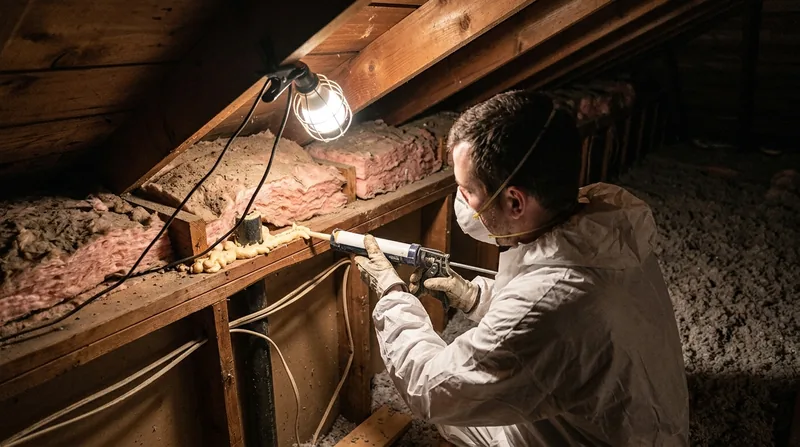




Air sealing in Little Rock stops humid outside air from leaking into your home all summer and cold drafts from pouring in during winter cold snaps. Little Rock sits in IECC climate zone 3A, hot and humid most of the year, with mild winters interrupted by sharp cold snaps. That combination drives moisture and temperature swings into homes through every gap in the building envelope. Whether you live in a Hillcrest bungalow, a mid-century ranch in North Little Rock, a newer subdivision west toward Maumelle, or a bonus room over a garage, air leaks in your top plate, around penetrations, and at rim joists let the outside air in and your conditioned air out. We seal those leaks with spray foam and mechanical testing, then verify the results with a blower door test so you know the job is done right. Proper air sealing cuts both your cooling load in summer and your heating loss in winter, and it works on homes built any decade across Pulaski and Saline counties.
Why Air Sealing Matters in Hot, Humid Little Rock Summers
Little Rock's climate is your air sealing problem. From May through September, outside humidity stays high while your air conditioner runs hard to keep indoor humidity down. Every air leak is a pathway for humid outside air to find its way into your walls, attic, and crawl space. That moisture condenses on cool surfaces, feeds mold growth, and forces your HVAC system to run longer and harder. Rim joists and band joists around crawl spaces are the worst culprits because they sit at ground level where moisture is highest. Top plates where walls meet attics leak cold air in winter and let your heat escape. Penetrations around plumbing, electrical, and HVAC ducts are often left open or poorly sealed by builders and earlier contractors.
- Humid air leaking into your attic condenses on cooler roof decks and wood framing, creating the conditions for mold and rot.
- Damp air entering crawl spaces through rim joists and band joists keeps subfloors wet and promotes decay of rim band lumber and rim board.
- Unsealed penetrations in top plates let conditioned air escape and outside air infiltrate, raising your cooling and heating costs year-round.
- Blower door testing measures your air leakage rate so you know exactly how much improvement the sealing has delivered.
The best time to address air leaks is before you add or upgrade insulation, because sealing stops the flow and insulation slows the transfer.
Key info: A home in Sherwood or Bryant built before 1990 typically has 15 to 25 air changes per hour (ACH) at 50 pascals of pressure. After proper air sealing, that same home often drops to 8 to 12 ACH, cutting your HVAC runtime and humidity swings significantly. A blower door test is the only way to measure it.
For more details on how insulation fits into the bigger picture, see our attic spray foam insulation page.
The Arkansas Building Code and the International Energy Conservation Code (IECC) govern air sealing requirements in Little Rock and surrounding cities. Your local building department enforces those standards, and the Arkansas Department of Energy and Environment oversees compliance statewide. Always verify code requirements with your city before starting any work.
How We Seal Air Leaks in Little Rock Homes
Air sealing is a systematic process that starts with a blower door test to identify where air is leaking, then sealing those specific locations with spray foam, caulk, and weather stripping. We work top to bottom: attic top plates and penetrations first, then wall cavities and rim joists, then crawl spaces. After sealing is complete, we run a second blower door test to verify the improvement and show you the results in writing. The whole job typically takes one to three days depending on the size of the home and the complexity of the leaks.
- We perform an initial blower door test to pressurize your home and measure baseline air leakage in cubic feet per minute (CFM).
- We identify and seal top plates where walls meet the attic using closed cell spray foam and caulk at all penetrations.
- We seal rim joists and band joists around crawl spaces with closed cell spray foam to stop humid air infiltration at ground level.
- We seal electrical, plumbing, and HVAC penetrations throughout the home with spray foam and foam backer rod.
- We run a final blower door test to verify the air leakage has dropped and document the improvement for your records.
Once air sealing is done, your home holds conditioned air better, your humidity swings are smaller, and your HVAC system runs less often.
Local example: A 1,800 square foot ranch in North Little Rock with a vented attic and unsealed crawl space typically has 12 to 18 CFM50 (cubic feet per minute at 50 pascals) of air leakage per 100 square feet of building envelope. After we seal the top plate, rim joists, and penetrations, that same home drops to 6 to 9 CFM50 per 100 square feet. Homeowners report noticeably steadier indoor temperatures and lower utility bills within the first month.
Learn more about how our rim joist and band joist sealing stops moisture at the foundation.
Air Sealing Methods and Approaches
| Approach | Description | Best for |
|---|---|---|
| Attic top plate sealing | Closed cell spray foam applied to the junction where walls meet the attic, sealing gaps in the top plate and around electrical and plumbing penetrations. | All homes with vented or unvented attics. Stops air infiltration at the warmest and coldest parts of the envelope. |
| Rim joist and band joist sealing | Closed cell spray foam applied to the rim band and band joist where the foundation meets the floor framing, blocking humid air from entering crawl spaces. | Homes with crawl spaces. Prevents moisture infiltration at ground level and protects rim lumber from rot. |
| Penetration sealing | Spray foam and foam backer rod applied around electrical boxes, plumbing stacks, HVAC ducts, and other holes through the building envelope. | Any home. Penetrations are often the biggest air leak per square inch and are easy to fix once identified. |
| Blower door testing | A calibrated door fan that pressurizes the home to measure air leakage before and after sealing, showing exactly how much improvement has been achieved. | All air sealing jobs. Proves the work was effective and gives you a baseline to compare against future energy audits. |
Air Sealing Cost in Little Rock: What to Expect
Air sealing in Little Rock typically starts at $650 to $1,200 for a small home or a single zone like a crawl space or attic top plate. A complete air sealing job on a 1,500 to 2,000 square foot home with multiple zones usually runs $1,500 to $3,000. Larger homes, homes with complex framing, and homes in Sherwood, Maumelle, or other areas farther from central Little Rock may cost more because of travel time and setup. The blower door test itself adds $200 to $400 to the job, but it is the only way to verify your air sealing actually worked.
The biggest factors that move the cost are the size of the home, the number of air leaks to seal, access to attics and crawl spaces, and whether you want blower door testing before and after. A ranch-style home in North Little Rock with an accessible attic and crawl space is faster and cheaper than a two-story in Hillcrest with tight rim joists and a complex roof line. Getting multiple estimates is always smart because different contractors may approach the job differently and price it differently. We provide written estimates with R-value and thickness specs, so you know exactly what you are paying for and can compare apples to apples.
For a detailed breakdown of our pricing on air sealing and other services, visit our pricing page.
What to Look for When Hiring an Air Sealing Contractor Near Little Rock
Air sealing is a technical job that requires precision and the right equipment to do well. When you are shopping for a contractor near Little Rock, Bryant, Sherwood, or anywhere else in Pulaski and Saline counties, there are several things you should verify before you sign a contract. First, ask for proof of current insurance and check that the coverage is active. Second, ask for at least two references from recent air sealing jobs so you can call and ask whether the work held up and the contractor was easy to work with. Third, get written estimates from at least two contractors so you can compare scope, materials, and price. Fourth, ask whether the estimate includes blower door testing, because a contractor who skips that step is guessing, not measuring.
- Verify the contractor is fully insured and ask to see a certificate of insurance naming your address as the work site.
- Check references from at least two recent air sealing jobs to confirm the work quality and the contractor's responsiveness after the job.
- Get written estimates from at least two contractors that detail the scope of work, materials, labor, and testing so you can compare fairly.
- Ask whether blower door testing is included and whether you will receive a written report showing CFM50 before and after sealing.
- Confirm the contractor understands local building code and permit requirements for air sealing in your specific city within Little Rock metro.
A contractor who avoids your questions, refuses to put an estimate in writing, or promises results without testing is a red flag. The honest move is to measure before and after, show you the results, and explain what was sealed and why. That is how you know the job is done right.
Ready to get started? Contact us for a free estimate or call (501) 588-2298 to discuss your air sealing needs.
Air Sealing in Little Rock: Pricing Guide
| Service | Price | Details |
|---|---|---|
| Attic top plate sealing only | Starting at $650 | Spray foam and caulk applied to top plate and electrical penetrations; does not include blower door testing |
| Rim joist and band joist sealing | Starting at $800 | Closed cell spray foam applied to foundation rim band and band joist in crawl space; labor and materials based on linear footage |
| Complete air sealing with blower door testing | Starting at $1,500 | Top plate, rim joists, penetrations sealed; blower door test before and after with written report documenting CFM50 improvement |
| Larger homes or multi-zone jobs | On estimate | Two-story homes, complex framing, multiple zones, or homes over 2,500 square feet require on-site assessment to price accurately |
| Travel | Included | in Little Rock, North Little Rock, Sherwood, Bryant, and surrounding Pulaski and Saline county areas; no separate mileage charge |
| Free estimate | No charge | Written estimate with scope details and pricing; response within 24 hours at (501) 588-2298; no obligation to book |
Indicative pricing, the exact cost depends on square footage, finish, and site access. Free personalized estimate within 24h at (501) 588-2298.


