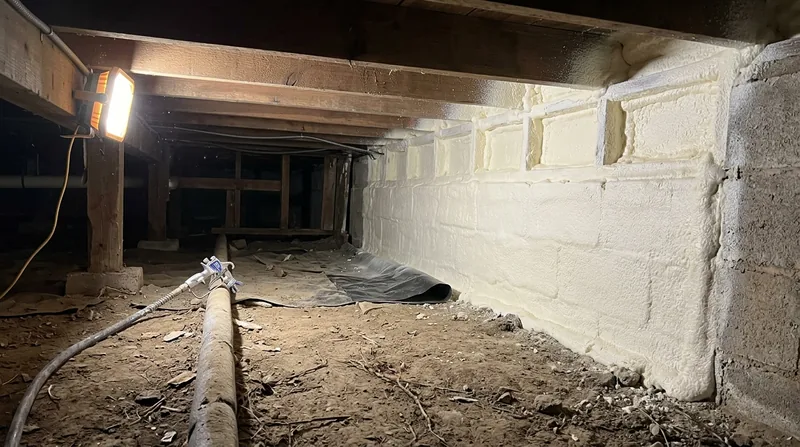




Crawl Space Spray Foam Insulation in Little Rock stops moisture before it gets under your house. Crawl spaces across Pulaski and Saline counties stay damp most of the year because humid outside air gets pulled in underneath, and that moisture works upward into subflooring, insulation, and the rooms above. Little Rock's climate is hot and humid, with temperatures that swing sharp in winter and stay heavy with moisture year-round. Older homes in Hillcrest and Pulaski Heights, mid-century ranches scattered through North Little Rock, and newer subdivisions toward Maumelle and Sherwood all sit on crawl space foundations that need protection. We spray foam the walls and band joist area to block that moisture at the source, so your foundation stays dry and your energy bills stop climbing.
Why Crawl Space Moisture Matters in Little Rock
A damp crawl space is not just uncomfortable; it pulls moisture upward through rim joists and rim band into the subfloor, where it weakens wood, feeds mold growth, and makes your HVAC system work overtime trying to condition air that started wet. In Little Rock's humidity-heavy climate, vented crawl spaces are a liability. Outside air flows in through vents, carrying moisture that condenses on cooler surfaces and collects on the floor. That damp air also carries allergens and odors up into living spaces. Spray foam on the walls and band joist seals the boundary between outside and inside, stopping the moisture source instead of fighting it with a dehumidifier that runs all year.
- We seal the band joist and rim area to stop air and moisture from entering underneath your house.
- Foam on crawl space walls creates a continuous moisture barrier that stays effective year after year.
- A sealed crawl space reduces the load on your HVAC system and lowers energy costs.
- Sealed foundations protect wood framing and insulation in the floor cavity from rot and mold.
Getting the crawl space sealed is the most direct path to a dry foundation in Little Rock's climate.
Key info: Pulaski County building departments require that any insulation work meet current energy code thermal barrier and ignition barrier rules, which vary by city. A mid-century ranch in North Little Rock and a newer home in Sherwood may have different code paths. Your local building department can tell you what applies at your address to get permits right.
For more information on how moisture affects insulation performance across our service areas, see our page on air sealing in Little Rock.
How We Seal Crawl Spaces in Little Rock
The job starts with a clear picture of what we are dealing with. We inspect the crawl space, check for standing water or active leaks, measure the square footage of walls and the linear feet of band joist, and identify any obstructions or access challenges. If there is water on the floor or the substrate is wet, we walk away; foam does not fix a wet crawl space, and we will not spray over moisture. Once the space is dry and ready, we spray closed cell or open cell foam depending on your needs and budget, apply it at the specified thickness per pass to hit the R-value required by code, and ensure proper ventilation during cure so off-gassing is controlled and re-entry is safe.
- We inspect the crawl space and verify the substrate is dry before any foam goes down.
- We measure walls and band joist area to calculate board feet and confirm the scope in writing.
- We spray foam at the correct thickness and ratio to meet code R-value requirements for your location.
- We provide mechanical ventilation during the cure window to manage fumes safely.
- We give you a re-entry window of 24 to 48 hours and clear guidance on when the space is safe to occupy.
Every crawl space job is different, and we size the scope and material to fit what the space needs.
Local example: A 1,200-square-foot ranch in Jacksonville with a crawl space foundation, 40 linear feet of band joist, and 800 square feet of perimeter wall might need 120 to 150 board feet of closed cell foam to seal the band and walls to code. The job takes one to two days depending on access and cure time, and the homeowner sees lower humidity and quieter HVAC operation within weeks.
For details on how crawl space sealing fits into a broader insulation and air-sealing strategy, see our rim joist and band joist spray foam page.
Crawl Space Spray Foam Insulation Methods
| Approach | Description | Best for |
|---|---|---|
| Closed Cell Spray Foam | High-density foam with closed cells that form a vapor barrier and air seal. Reaches R-7 per inch. Resists moisture and provides structural support. | Crawl spaces in humid climates where moisture control is the priority, and where the extra R-value per inch matters in tight spaces. |
| Open Cell Spray Foam | Lower-density foam with open cells that allow vapor to pass through. Reaches R-3.5 per inch. Less expensive per board foot and easier to work with in large spaces. | Crawl spaces where budget is a concern and where the crawl space is already dry and well-ventilated, or where vapor permeability is an advantage. |
| Band Joist Seal Only | Foam applied to the rim band and joist area only, sealing the air gap where outside air enters the house most aggressively. Walls may be left unfoamed if already insulated. | Homes where the band joist is the primary air leak and existing wall insulation is adequate, or where budget limits the scope to the highest-impact area. |
| Full Crawl Space Enclosure | Foam applied to walls and band joist, creating a fully sealed and insulated crawl space envelope. Provides the highest R-value and moisture control. | Crawl spaces in high-humidity areas like Little Rock where moisture is the dominant failure mode, or where the crawl space will be used for storage or conditioned space. |
Crawl Space Spray Foam Insulation Cost in Little Rock: What to Expect
Crawl space foam jobs in Little Rock start at around $2,500 to $4,000 for a smaller ranch or a band joist seal on a 1,000 to 1,200 square foot home, and climb from there depending on the size of the crawl space, the linear footage of band joist, the type of foam, and the access. A larger mid-century home in Pulaski Heights or a two-story in Maumelle with a bigger crawl space footprint may run $5,000 to $8,000 or more. The main drivers are square footage of walls to foam, whether you choose closed cell (more expensive, higher R-value, better moisture control) or open cell (lower cost per board foot), and how easy it is for our crew to reach and spray the space. If the crawl space is tight, has low clearance, or has obstacles like HVAC ducts or plumbing, the labor goes up. If there is standing water or the substrate is wet, we do not spray until that is fixed, and moisture remediation is a separate cost.
We always start with a free, on-site estimate where we measure the space, discuss your moisture concerns, and explain the material choices so you understand what drives the price. Getting 2 or 3 estimates from different contractors is smart; you will see the cost range and understand why the numbers differ. Some estimators will give you a price per board foot without seeing the job; that is a red flag. We give you a written estimate with R-value and thickness specs so you know exactly what you are paying for.
For a detailed look at pricing across all our services, visit our full pricing page.
Crawl Space Spray Foam Insulation Near Me: What Little Rock Homeowners Should Know When Hiring
Hiring a spray foam contractor is a decision that affects your home's durability and your family's comfort for years. When you are looking for someone to seal your crawl space in Little Rock, North Little Rock, Sherwood, or the surrounding Pulaski County area, there are concrete things to check. First, verify that the contractor is fully insured with general liability and workers compensation; ask to see the certificate of insurance and confirm the coverage is current. Second, get written estimates from at least two contractors that spell out the R-value, the thickness per pass, the total board feet, and the material type (closed cell or open cell). An estimate with no specs is a sign the contractor does not know what they are doing or does not plan to do the job right. Third, ask about their cure and re-entry process; a reputable installer will tell you they use mechanical ventilation during cure and will give you a clear re-entry window of 24 to 48 hours. If someone promises immediate re-entry or says the smell will be gone in a few hours, walk away. Fourth, check whether your city requires a permit for insulation work; Little Rock, North Little Rock, Sherwood, Jacksonville, and other Pulaski County cities have different rules, and a good contractor will help you navigate what applies at your address.
- Verify the contractor carries full insurance with a current certificate of liability and workers compensation.
- Request a written estimate that includes R-value, thickness, board feet, and material type so you can compare apples to apples.
- Ask about their ventilation and cure process; mechanical ventilation during cure is the standard, not an upgrade.
- Confirm whether a permit is required at your address by checking with your local building department or asking the contractor to clarify.
- Check references from recent crawl space jobs and ask about moisture control, smell, and how the space has held up since the work.
A local contractor with a local address and local plates who takes time to inspect your space and answer your questions is your best bet.
Ready to get started? Contact us for a free estimate or call (501) 588-2298. We will walk your crawl space, explain your options, and give you a price in writing with no obligation to book.
Crawl Space Spray Foam Insulation in Little Rock: Pricing Guide
| Service | Price | Details |
|---|---|---|
| Band Joist Seal (Rim Area Only) | Starting at $2,500 | Foam applied to rim band and joist, the highest-impact air leak point; typical for smaller homes or tight budgets |
| Full Crawl Space Enclosure | Starting at $4,500 | Walls and band joist foamed for complete moisture and air seal; size and access determine final cost |
| Larger or Complex Crawl Space | On estimate | Crawl spaces over 1,500 sq ft, low clearance, obstructions, or wet substrate require site inspection for accurate pricing |
| Travel and Setup | Included | No separate mileage or travel fee for jobs in Little Rock and surrounding Pulaski, Saline, Lonoke, and Faulkner counties |
| Free Estimate | No charge | On-site measurement and written specs with R-value and thickness; response within 24 hours at (501) 588-2298 |
Indicative pricing, the exact cost depends on square footage, finish, and site access. Free personalized estimate within 24h at (501) 588-2298.


