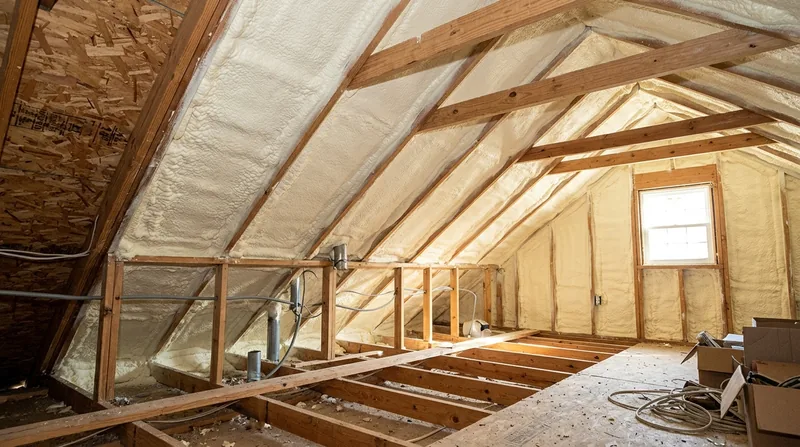




Attic spray foam insulation in Little Rock transforms vented attics into conditioned space, cutting summer heat gain across Hillcrest bungalows, West Little Rock two-stories, and mid-century ranches alike. Central Arkansas sits in IECC climate zone 3A, where hot, humid summers drive moisture inward through the building envelope while vented attics bake under direct sun exposure. A typical Little Rock home loses 25 to 40 percent of its conditioned air through an uninsulated or poorly sealed attic, pushing cooling costs higher every June through September. Spray foam applied directly to the roof deck seals air leaks at the same time it insulates, stopping heat gain before it reaches living space below. The result is lower utility bills, more stable indoor temperatures, and relief from the hot upper floors that plague two-story homes across the metro.
Why Attic Spray Foam Insulation Matters in the Little Rock Climate
Little Rock's summer heat and year-round humidity create a specific failure mode: vented attics pull in hot, moist outside air while the roof deck bakes under direct sun. That combination drives indoor moisture upward into the attic space, where it condenses on cooler surfaces and degrades fiberglass batts. Spray foam seals the attic boundary at the roof deck itself, eliminating the vented air path and stopping the moisture cycle before it starts. Older homes in Hillcrest and Pulaski Heights, newer subdivisions toward Maumelle and Sherwood, and mid-century ranches scattered across North Little Rock all benefit from the same principle: a sealed attic is a dry attic, and a dry attic costs less to cool.
- Stops heat gain by sealing the attic boundary at the roof deck, not the floor joists.
- Eliminates the vented air path that pulls hot, humid outside air into the attic cavity.
- Prevents moisture condensation on insulation and roof framing by controlling the air temperature inside the attic space.
- Allows HVAC ducts and equipment in the attic to operate at near-indoor temperatures, improving cooling efficiency.
- Protects roof framing from the moisture and temperature swings that accelerate wood rot and fastener corrosion.
A sealed attic is the single most effective upgrade for homes across the Little Rock metro, whether the goal is cutting energy bills or protecting the structure itself.
Key info: Little Rock's building code requires a thermal barrier (fifteen-minute rated material) between foam and interior living space, and an ignition barrier between foam and the attic side. Both are installed as part of the spray foam system. Verify current code requirements with your local building department before any work begins. Permits are required in most Little Rock jurisdictions, and requirements vary by city.
For detailed guidance on closed-cell versus open-cell foam, see our page on closed cell spray foam insulation, which covers the technical and cost differences.
How We Seal and Insulate Attics in Little Rock: The Process
Attic spray foam work starts with a site assessment to identify air leaks, existing insulation condition, roof deck access, and any moisture or structural issues. We measure the attic space, confirm roof deck condition and thickness, and discuss whether closed-cell or open-cell foam is the right fit for your home. Once you approve the estimate, we schedule the work, arrange temporary ventilation if needed, and coordinate with your local building department on permitting. The actual spray takes one to three days depending on attic size and complexity, followed by a twenty-four to forty-eight hour cure period before normal attic access resumes.
- We inspect the attic for roof leaks, moisture damage, or structural concerns before any foam is applied.
- We remove or encapsulate existing insulation, air-seal gaps around ducts and penetrations, and prepare the roof deck surface.
- We apply foam to the specified thickness and R-value, maintaining correct drum temperature and manufacturer mix ratio throughout.
- We run mechanical ventilation during cure and enforce the re-entry window stated on the foam system safety data sheet.
- We install required thermal and ignition barriers per local building code, then schedule final inspection with your city or county.
The entire process is transparent: we provide written estimates with R-value and thickness specs, schedule around your calendar, and stay on site until the work is complete and the attic is ready for normal use.
Example: A West Little Rock two-story with a 1,200 sq ft attic, vented before insulation, typically takes two days to spray. We seal the roof deck with 5.5 inches of closed-cell foam (R-33 nominal), install the thermal barrier, and coordinate the final inspection with the city. Total cure time is forty-eight hours. The homeowner then sees cooling costs drop 20 to 30 percent by September.
For more detail on air sealing as a standalone service, visit air sealing in Little Rock.
Attic Spray Foam Insulation Methods: Closed Cell vs. Open Cell
| Approach | Description | Best for |
|---|---|---|
| Closed-Cell Spray Foam | High-density foam (3.5 to 4.5 lb/cu ft) with closed cells. R-value approximately 6.0 to 6.5 per inch. Vapor barrier and air barrier in one pass. Resists moisture and condensation. | Hot, humid climates like Little Rock where moisture control is critical. Sealed attics in homes with HVAC ducts and equipment in the attic cavity. |
| Open-Cell Spray Foam | Low-density foam (0.5 to 1.5 lb/cu ft) with open cells. R-value approximately 3.5 to 3.8 per inch. Allows vapor transmission. Lower cost per board foot than closed-cell. | Attics where moisture control is passive (roof deck is dry, no standing water risk) and thickness is not limited by clearance. Budget-conscious homeowners seeking improved comfort. |
| Closed-Cell Over Existing Insulation | Spray 2 to 3 inches of closed-cell foam over sound batts or blown-in fiberglass to add R-value and seal air leaks without full attic removal. | Retrofit jobs in Hillcrest and North Little Rock where existing insulation is still performing but R-value is insufficient for current energy codes. |
| Full Attic Removal and Closed-Cell Replacement | Remove deteriorated, compressed, or contaminated insulation, clean the attic space, then spray closed-cell foam to the design R-value and thickness. | Older homes where batts are matted or wet, where prior water damage is present, or where the attic has been used for storage and insulation is compromised. |
The choice between closed-cell and open-cell depends on your climate (humidity, moisture risk), your budget, and whether the attic is already partially insulated. In Little Rock's hot, humid climate, closed-cell is the standard choice for sealed attics because it controls moisture and delivers higher R-value per inch. Open-cell spray foam is appropriate for specific retrofit scenarios where moisture is not a concern and cost is the priority.
Attic Spray Foam Insulation Cost in Little Rock: What to Expect
Attic spray foam insulation in Little Rock typically starts at $1.50 per square foot for open-cell foam on a straightforward retrofit, and $2.00 to $3.50 per square foot for closed-cell foam with full air sealing and thermal barrier installation. The final cost depends on several concrete factors: attic size and complexity, whether existing insulation must be removed, roof deck condition and accessibility, the R-value and thickness specified, and whether mechanical ventilation during cure requires temporary ducting. A 1,200 sq ft attic with closed-cell foam to R-33 typically ranges from $2,400 to $4,200 before permitting. Larger attics or jobs requiring full removal cost more; smaller attics or simple open-cell overlays cost less.
The best approach is to get two to three written estimates from local contractors, each with R-value and thickness clearly stated, so you can compare apples to apples. Estimates should include the cost of thermal and ignition barriers, mechanical ventilation during cure, and any required permitting. Avoid any quote that omits R-value, thickness, or re-entry time, or that promises work to start immediately without an inspection or a permit discussion.
For a detailed breakdown of pricing by service type and region, visit our pricing page.
Attic Spray Foam Insulation Near Me: What Little Rock Homeowners Should Know When Hiring a Contractor
Finding the right spray foam contractor in Little Rock means checking three things: insurance and verifiable coverage, a detailed written estimate with R-value and thickness, and references from recent local jobs. The spray foam trade includes both local independent shops and national franchises, and also includes rig-and-run crews operating out-of-state trailers. The local independent is the strongest choice because you can verify insurance directly, follow up with references who live in your neighborhood, and reach someone if questions arise after the job is complete. Before you hire, confirm that the contractor can explain the difference between closed-cell and open-cell foam, can name the thermal and ignition barriers required by Little Rock code, and can walk you through the re-entry window and cure timeline.
- Verify that the contractor carries general liability and property damage insurance, and request a certificate of insurance before work begins.
- Ask for a written estimate that specifies R-value, foam thickness in inches, the type of thermal barrier used, and the re-entry window.
- Request references from at least two jobs completed in Little Rock or nearby areas within the past twelve months, and call them to ask about the quality of the work and the contractor's responsiveness.
- Confirm that the contractor understands your local building code, will pull the required permit, and will coordinate the final inspection with your city or county.
- Ask whether the contractor carries a one to three year workmanship warranty, and get the warranty terms in writing.
Once you have selected a contractor, schedule a free estimate. Contact us at (501) 588-2298 for a no-obligation assessment of your attic and a written quote with all specs included.
Attic Spray Foam Insulation in Little Rock: Pricing Guide
| Service | Price | Details |
|---|---|---|
| Open-Cell Spray Foam Attic Overlay | Starting at $1.50/sq ft | Spray over existing sound insulation to add R-value and seal air leaks without full removal or containment |
| Closed-Cell Spray Foam, Sealed Attic | Starting at $2.00/sq ft | Full roof deck seal with closed-cell foam, thermal barrier, ignition barrier, and mechanical ventilation during cure |
| Full Attic Removal and Closed-Cell Replacement | Starting at $2.50/sq ft | Remove deteriorated insulation, clean attic space, spray closed-cell foam to design R-value, install barriers and coordinate inspection |
| Attic Assessment and Written Estimate | Free | On-site inspection, R-value and thickness recommendation, written quote with no obligation to book, response within 24 hours |
| Travel and Mobilization | Included | No separate mileage fee or travel charge for jobs in Little Rock and surrounding Pulaski County service areas |
Indicative pricing, the exact cost depends on square footage, finish, and site access. Free personalized estimate within 24h at (501) 588-2298.


