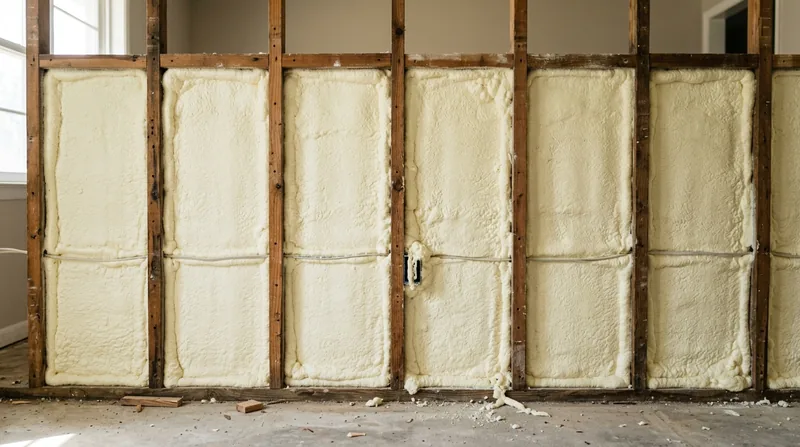




Open cell spray foam insulation in Little Rock fills stud bays and rafter cavities across the metro's mixed housing stock, from older Hillcrest homes to newer builds toward Maumelle and Sherwood. In climate zone 3A, where hot summers drive moisture inward through the building envelope and damp crawl spaces pull humid air against subfloors, open cell foam expands to seal gaps and reduce the load on air conditioning systems that run hard most of the year. The product is less dense than closed cell, costs less per board foot, and absorbs sound, making it the right choice for attics, interior walls, and rooms over garages where thermal performance and noise control matter equally. We've installed open cell foam across Pulaski, Saline, Lonoke, Faulkner, Jefferson, and White counties since 2009, and we size every job to the actual cavity, the climate, and your budget. Call us at (501) 588-2298 for a free written estimate with R-value and thickness specs, or visit our attic spray foam insulation page to see how we handle the signature job of the trade.
Why Open Cell Spray Foam Matters in Little Rock's Hot, Humid Climate
Little Rock summers are long and hot, with humidity that stays high most of the year. Vented attics over older ranches and newer two-story homes bake in the sun, and that heat radiates down through the ceiling into living spaces below. Damp crawl spaces and rim joists pull moisture inward through the building envelope, and fiberglass batts do nothing to stop air leakage at the edges. Open cell foam seals those gaps tight, expands to fill every cavity, and lets moisture vapor move through the cured foam so it does not trap water in the wood.
- Reduces attic temperature by 10 to 15 degrees on a summer afternoon, cutting cooling load and runtime.
- Seals air leaks around electrical boxes, ductwork, and rim joists where fiberglass leaves gaps.
- Absorbs sound from rain on the roof and traffic outside, a benefit fiberglass does not deliver.
- Permits moisture vapor to pass through once cured, so trapped humidity does not degrade wood framing or subfloors.
- Works in walls, attics, and crawl spaces without the cost premium of closed cell foam when R-value per inch is less critical.
Open cell foam is the practical answer for Little Rock's climate and for homeowners who want to seal air leaks, reduce noise, and keep energy bills in line without overpaying for closed cell when the job does not demand it.
Key info: Little Rock's building code and energy code are set by your city and building department. Attic ventilation rules, ignition barriers, and thermal barriers vary from North Little Rock to Sherwood to Benton. Your local building department can tell you what applies at your address, and we defer to the local building official on every detail.
For more on how spray foam performs in hot climates, see the U.S. Environmental Protection Agency's guide to air sealing and insulation.
How We Install Open Cell Spray Foam Insulation in Little Rock
Open cell foam is sprayed from a heated rig, expands as it exits the nozzle, and cures in place. The process requires control of temperature, spray pattern, and pass thickness to hit the target R-value without over-application. We work room by room or attic by attic, mechanically ventilate during cure to manage off-gassing, and observe a re-entry window of 24 to 48 hours before the space is occupied. The foam hardens to a light tan, semi-rigid state that you can cut, drill, or route if future work is needed.
- We inspect the cavity, identify air leaks, and mark areas that need foam or sealant.
- We set up mechanical ventilation and establish a re-entry window of 24 to 48 hours.
- We spray open cell foam at the correct thickness per pass, typically 1 to 2 inches, to reach the target R-value for your attic or wall cavity.
- We allow the foam to cure, then trim excess foam flush with the cavity edge so it does not overfill.
- We provide a written inspection report showing R-value and thickness so you have proof of the work.
On a typical attic job in Little Rock, we can spray 1,200 to 1,800 board feet in a single day, depending on cavity layout and access. For more detail on our attic process, visit our attic spray foam insulation page.
Local example: A 1,500-square-foot attic in West Little Rock with 6-inch rafter bays and existing fiberglass batts requires removal of the old insulation, air sealing of the rim band and ductwork, and 3.5 inches of open cell foam to reach R-21. That job runs 4 to 6 hours on site, with re-entry in 48 hours.
Open Cell Spray Foam Installation Methods
| Approach | Description | Best for |
|---|---|---|
| Attic fill | Spray open cell foam between rafters or across the attic floor to the target R-value, then trim flush. | Vented attics in Hillcrest, Pulaski Heights, and newer subdivisions toward Maumelle seeking to reduce cooling load. |
| Wall cavity fill | Spray open cell foam into stud bays from inside or outside, filling gaps around electrical boxes and blocking. | Interior remodels and new construction in Little Rock and surrounding Pulaski County neighborhoods. |
| Garage ceiling | Spray open cell foam between joists above attached garages to reduce heat loss and sound from the garage below. | Bonus rooms and living spaces over garages in newer builds, where temperature and noise control are priorities. |
| Rim and band joist | Spray open cell foam along the rim band and band joist to seal the junction between foundation and framing. | Crawl space homes in North Little Rock and Pulaski County where air leakage at the rim is driving humidity and infiltration. |
| Retrofit top-up | Add open cell foam over existing insulation to reach a higher R-value without full removal. | Attics with sound fiberglass where a modest R-value boost is the goal and removal cost is a concern. |
Open Cell Spray Foam Insulation Cost in Little Rock: What to Expect
Open cell spray foam costs starting at $0.55 per board foot for material and labor in Little Rock and surrounding areas. A typical 1,200-board-foot attic job runs $660 to $1,200 depending on cavity depth, access difficulty, and whether existing insulation must be removed first. Removal of old fiberglass or blown-in insulation adds $0.15 to $0.30 per square foot. Mechanical ventilation during cure, air sealing around penetrations, and trim work are included in our estimate. We provide a written estimate with R-value and thickness specs so you know exactly what you are paying for before we start work.
Factors that move the cost up or down include cavity depth (deeper cavities require more material), access (attics with limited headroom take longer), existing insulation (removal adds time and disposal cost), and local permitting (some cities require inspection, which adds a day or two to the schedule). Travel to North Little Rock, Sherwood, Bryant, or Benton is included in our service area, with no separate mileage charge. For a detailed breakdown of pricing by job type, visit our full pricing page.
The best way to know your cost is to call us at (501) 588-2298 for a free estimate. We measure the space, discuss your R-value goal, and provide a firm price in writing with no obligation to book.
Open Cell Spray Foam Insulation Near Me: What Little Rock Homeowners Should Know When Hiring
The spray foam market includes rig-and-run crews from out of state (trailer in, job sprayed in an afternoon, nobody reachable when the smell will not go away), national franchises, and local independents. The difference is in the details: an estimate with no R-value and no thickness specification is a red flag, as is a price far below market with no inspection. Mechanical ventilation during cure is not optional, and a promise of immediate re-entry is a marker of poor work. When you call a contractor, ask to see proof of insurance, ask what R-value and thickness you will receive, and ask how long the re-entry window is.
- Verify that any contractor is fully insured and ask for a certificate of insurance before work begins.
- Get at least two written estimates that name the R-value, thickness, and board footage so you can compare apples to apples.
- Ask about the re-entry window, mechanical ventilation during cure, and the curing time before you can enter the space.
- Check references from recent jobs in your neighborhood, Little Rock or North Little Rock, so you can see the work and hear from homeowners.
- If your home is in an HOA or a historic district, verify that exterior work or attic access complies with local architectural rules before you book.
We are fully insured, we provide written estimates with R-value and thickness, and we observe a 24 to 48 hour re-entry window on every job. Call us at (501) 588-2298 to schedule your free estimate and ask any questions about our process, insurance, or references in your area.
Open Cell Spray Foam Insulation in Little Rock: Pricing Guide
| Service | Price | Details |
|---|---|---|
| Open cell spray foam, standard attic | Starting at $0.55/board ft | Material and labor for 3 to 5 inch depth in rafter cavities, includes mechanical ventilation during cure and 24 to 48 hour re-entry window |
| Removal of existing insulation | Starting at $0.15/sq ft | Disposal of fiberglass batts or blown-in insulation before open cell foam installation, varies by density and contamination |
| Wall cavity or rim joist fill | Starting at $0.55/board ft | Open cell foam into stud bays or band joists, includes air sealing around electrical boxes and ductwork penetrations |
| Garage ceiling or bonus room | Starting at $0.55/board ft | Open cell foam between joists for thermal and sound control, typical 500 to 1000 board foot job in West Little Rock or newer subdivisions |
| Large or complex job | On estimate | Multi-story retrofit, sealed attic with HVAC, or mixed open and closed cell requires on-site measurement and code review |
| Free estimate | No charge | Written quote with R-value, thickness, and board footage within 24 hours, valid for 30 days, no obligation to book |
Indicative pricing, the exact cost depends on square footage, finish, and site access. Free personalized estimate within 24h at (501) 588-2298.


