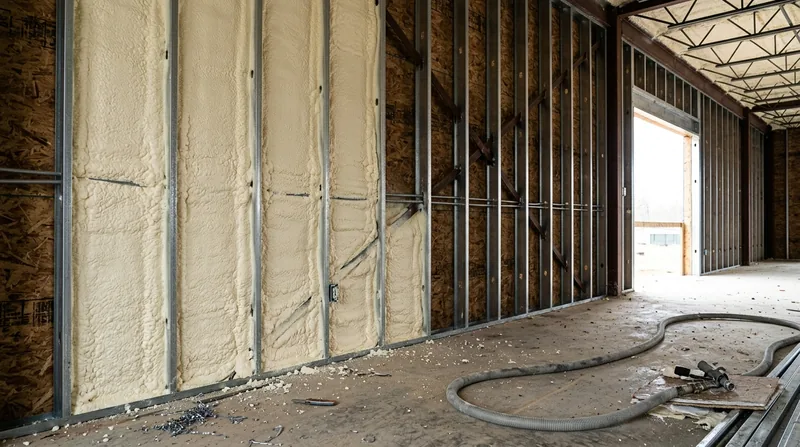




Commercial & New Construction Spray Foam in Little Rock requires planning before drywall closes in. Builders and contractors across Pulaski and Saline counties work with us to insulate attics, walls, and metal shells while framing is open and access is simple. Central Arkansas sits in IECC climate zone 3A, where hot attics bake roof decks and humid air drives inward through weak building envelopes, driving energy bills from day one. New construction gives you one chance to get the thermal envelope right. We spray foam walls, sealed attics, and metal building shells on schedule, with written estimates that name R-value and thickness so you know what you are paying for.
Why Spray Foam Insulation Matters for New Construction in Little Rock and Pulaski County
New buildings in the Little Rock metro face the same moisture and heat challenge that older homes do: vented attics pull damp outside air across the building envelope while summer heat bakes the roof deck. The difference is that new construction lets you seal the attic or the roof deck itself with spray foam before anyone moves in, eliminating the energy leak before it starts. Closed cell foam stops air leakage and controls moisture on metal building shells where condensation would otherwise form on cold steel. Open cell foam works in sealed attics where moisture control is less critical. The choice depends on your building type, climate zone, and code requirements at your address.
- We spray foam attics and sealed roof decks before roofing material goes down.
- We insulate walls in new homes before drywall closes in, with no demolition and no waste.
- We seal metal building shells and barndominiums to stop condensation on steel framing.
- We work to your builder's schedule and coordinate with other trades on site.
- We provide written estimates that specify R-value, thickness, and board-foot coverage.
Spray foam on new construction is faster and cleaner than retrofit work because the building is still open and crews have full access to every cavity.
Key info: Little Rock's newer subdivisions in West Little Rock and toward Maumelle often include bonus rooms over garages and vented attics that need sealed roof decks or conditioned attics. Spray foam planned during framing saves energy bills and avoids retrofit costs later. Call us early in the build cycle so we fit into your trade schedule.
For more on how spray foam works in different building types, see our guide to attic spray foam insulation and metal building spray foam.
How We Work with Builders and Contractors on New Construction Spray Foam Projects
New construction insulation work starts with a site walk and a clear understanding of your code requirements and your builder's timeline. We work with general contractors, framers, and metal building crews to fit spray foam into the trade sequence. Most new construction jobs involve attic or sealed roof deck insulation, wall cavities, or metal shell condensation control. We arrive after framing is complete and before drywall or roofing closes in, spray to specification, and move on schedule so other trades stay on track.
- We schedule work around your builder's trade sequence and coordinate with framers and roofers.
- We inspect the framing and substrate to confirm it is clean, dry, and ready for foam.
- We spray to the thickness and R-value specified in the estimate, with mechanical ventilation during cure.
- We provide a written summary of what was sprayed, where, and the coverage in board feet.
- We confirm re-entry windows and any thermal or ignition barrier requirements your building code requires.
Builders who work with us know they will get a clean, predictable insulation job that meets code and closes on time.
Example: A new construction project in Sherwood with a sealed attic over a bonus room called for closed cell foam to R-30 thickness. We coordinated the spray with the roofer, used mechanical ventilation during cure, and provided a board-foot summary and R-value documentation for the builder's energy code file. The job stayed on schedule and the homeowner got a conditioned attic that will not pull damp air from the crawl space.
Learn more about our closed cell spray foam options for high-performance new construction work.
Spray Foam Methods for New Construction: Attics, Walls, and Metal Buildings
| Method | Description | Best for |
|---|---|---|
| Closed Cell Attic Foam | High-density foam sprayed to 4 to 6 inches on roof deck or attic floor, R-6 to R-7 per inch, stops air leakage and controls moisture in hot, humid climates. | Sealed roof decks, bonus rooms, metal building condensation control, high-performance new builds. |
| Open Cell Attic Foam | Low-density foam sprayed to 5 to 7 inches on roof deck, R-3.6 per inch, allows vapor diffusion and dampens sound, cheaper than closed cell. | Sealed attics where condensation risk is low, sound dampening over bonus rooms, budget-conscious new construction. |
| Wall Cavity Foam | Closed or open cell foam sprayed into wall cavities before drywall, fills irregular framing and around wiring, seals air leaks and reduces thermal bridging. | New construction homes, energy-efficient walls, retrofit of pre-1980 homes without demolition. |
| Metal Building Shell Foam | Closed cell foam sprayed on underside of metal roof or wall panels, controls condensation on cold steel, typical thickness 2 to 4 inches. | Barndominiums, metal pole barns, commercial metal buildings, shops across Pulaski County. |
Commercial & New Construction Spray Foam Cost in Little Rock: What to Expect
New construction spray foam costs depend on the scope, the foam type, and the building size. Closed cell foam runs higher per board foot because it is denser and carries better R-value, but it is the right choice for metal buildings and high-performance sealed attics. Open cell foam costs less and works well in sealed attics where moisture risk is low. Wall cavity foam in new framing is typically cheaper than retrofit work because walls are open and access is simple. A free commercial estimate is the only honest starting point because spray foam is priced by board foot on site, and board-foot volume depends on cavity size, foam thickness, and whether you are filling walls, sealed attics, or metal shells.
- Closed cell foam runs from $1.50 to $2.25 per board foot plus labor, typical for sealed attics and metal building shells.
- Open cell foam runs from $0.75 to $1.25 per board foot plus labor, standard for sealed attics in new homes.
- Wall cavity foam in new framing costs less per board foot than retrofit work because demolition is not needed.
- Metal building condensation control typically runs $2.00 to $3.00 per board foot because closed cell is required and coverage is often high.
- Travel is included in Little Rock and surrounding areas, no separate mileage charge.
Call us at (501) 588-2298 for a free estimate on your new construction project. We will walk the site, measure the cavities, confirm your code requirements, and provide a written estimate with R-value and thickness specs so you know exactly what you are paying for and what you are getting.
For detailed pricing context, see our pricing overview.
What to Look for When Hiring a Spray Foam Contractor Near Little Rock for New Construction
Hiring the right spray foam contractor for new construction means checking more than price. A reputable contractor will provide a written estimate that names R-value and thickness, confirm that the substrate is clean and dry before spraying, use mechanical ventilation during cure, and respect re-entry windows and code requirements at your address. Permitting and thermal barrier rules vary by city across Greater Little Rock, so a contractor who defers to your local building department and confirms what applies at your address is the one to trust. Avoid any estimate with no R-value and no thickness, any promise of same-day re-entry, or any price far below market without inspection.
- Ask for a written estimate that specifies foam type, R-value per inch, total thickness, and board-foot coverage.
- Confirm that the contractor will inspect the framing and substrate before spraying and walk away if it is wet or contaminated.
- Verify that mechanical ventilation will be used during cure and that re-entry windows are stated in writing.
- Ask about thermal barrier and ignition barrier requirements at your address and confirm the contractor knows your building code.
- Check references from other builders and confirm that the contractor coordinates with other trades on schedule.
- Confirm that the contractor is fully insured and ask to see the certificate of insurance.
A contractor who asks about your code requirements, walks the site before estimating, and provides a written spec is the one who will deliver a clean, code-compliant job that protects your investment.
Ready to move forward? Contact us for a free estimate or call (501) 588-2298 to discuss your new construction project.
Commercial & New Construction Spray Foam in Little Rock: Pricing Guide
| Service | Price | Details |
|---|---|---|
| Free Commercial Estimate | Free | Site walk, cavity measurement, foam type recommendation, written estimate with R-value and thickness specification |
| Closed Cell Spray Foam | $1.50 to $2.25 per board foot | Labor included, mechanical ventilation during cure, best for sealed attics and metal building condensation control |
| Open Cell Spray Foam | $0.75 to $1.25 per board foot | Labor included, ideal for sealed attics in new construction where moisture risk is lower than hot climates |
| Wall Cavity Foam | $0.80 to $1.40 per board foot | Labor included, new construction framing open access, significantly cheaper than retrofit cavity fill without demolition |
| Metal Building Shell Foam | $2.00 to $3.00 per board foot | Closed cell required for condensation control on steel, labor included, barndominiums and commercial metal buildings |
| Travel | Included | No separate mileage or travel fee in Little Rock, North Little Rock, Sherwood, and surrounding service areas |
Indicative pricing, the exact cost depends on square footage, finish, and site access. Free personalized estimate within 24h at (501) 588-2298.


