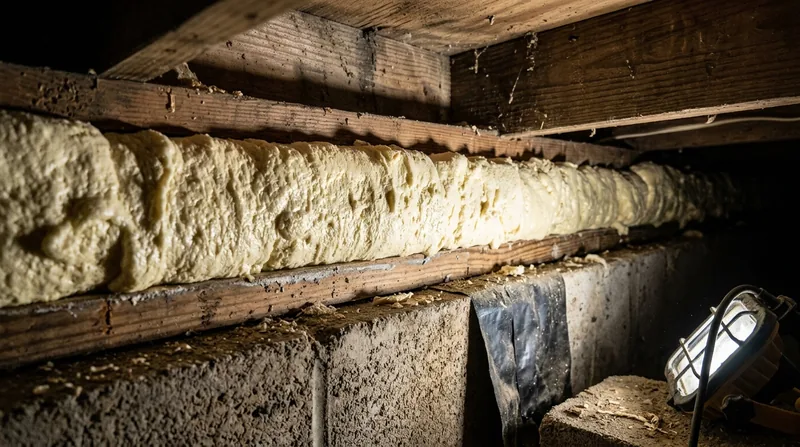




Closed cell spray foam insulation in Little Rock is the heavy-duty choice for Little Rock's hot, humid climate. Zone 3A summers drive moisture inward through vented attics and crawl spaces, and damp air pulls relentlessly against subfloors and rim joists across Pulaski and Saline counties. Closed cell foam stops that moisture dead and builds an air barrier where it matters most: at rim joists in older Hillcrest and Pulaski Heights homes, crawl space walls under mid-century ranches, garage ceilings over bonus rooms, and metal building walls scattered across the metro. Its higher R-value per inch and vapor resistance make it the right tool for the job in this climate, and for crawl spaces and garages where moisture control is non-negotiable.
Why Closed Cell Spray Foam Matters in Little Rock's Hot, Humid Climate
Little Rock sits in the heart of IECC climate zone 3A, where summer heat bakes roof decks and humidity stays high most of the year. Vented attics pull damp outside air across floor joists and subfloors. Crawl spaces under older homes and mid-century ranches hold moisture against band joists and rim joists, and that moisture drives energy bills up while wood rot and mold risk climb. Closed cell foam seals the air leaks that let that humid air in, and its vapor resistance stops moisture from moving through the foam itself.
- Closed cell foam delivers 6.0 to 7.0 R-value per inch, so a 2-inch coat on a rim joist or crawl space wall stops both air leakage and moisture penetration in one pass.
- The material cures to a rigid, load-bearing foam that holds up against settling and vibration in garages and metal buildings without sagging or cracking.
- Vapor resistance of 1.5 to 2.0 perms per inch means moisture cannot move through the foam, which is critical in crawl spaces and under bonus rooms where damp subfloor air would otherwise condense on cold surfaces.
- Closed cell foam bonds tightly to rim joists, band joists, and concrete crawl space walls, sealing cracks and gaps that open cell or fiberglass cannot reach.
These properties make closed cell the standard for moisture-critical zones in the Little Rock area, and the reason it commands higher cost than open cell.
Key info: Little Rock's building stock ranges from older homes in Hillcrest and the Quapaw Quarter with shallow crawl spaces, to mid-century ranches with vented attics and rim joists exposed to outdoor humidity, to newer subdivisions in West Little Rock and Sherwood with bonus rooms over garages. Closed cell foam is the answer for all three when moisture or air sealing is the problem. For technical guidance on what code requires at your address, contact the building department in your city (Little Rock, North Little Rock, Sherwood, Jacksonville, Maumelle, or Bryant), as thermal barrier and ignition barrier rules vary.
Learn more about crawl space spray foam insulation and rim joist and band joist spray foam for the two most common applications of closed cell in the Little Rock area.
How We Install Closed Cell Spray Foam in Little Rock Attics, Crawl Spaces, and Garages
Closed cell spray foam installation is precision work. The foam is mixed on site at the exact ratio and temperature the manufacturer specifies, sprayed in controlled passes to the thickness you need, and cured under mechanical ventilation so the chemical off-gassing happens safely and the foam hardens to full strength. The whole process is managed to code, with written estimates that spell out R-value and thickness before we start, and a re-entry window of twenty-four to forty-eight hours after the last pass.
- We inspect the substrate (attic decking, crawl space walls, rim joists, or garage ceiling) for moisture, leaks, or contamination, and we walk away if the surface is not dry.
- We set up mechanical ventilation in the work area and position the spray rig outside or in a staging zone, so fumes exit the building during and immediately after application.
- We spray the foam in thin, even passes, building thickness incrementally so the foam cures properly and does not trap heat or moisture in the middle of the bead.
- We verify the final thickness with a probe or calipers and document it against the estimate, so you have proof of R-value.
- We leave mechanical ventilation running for the full cure window and provide you with a re-entry timeline in writing.
This discipline is what separates a sound installation from the rig-and-run crews that spray thick, fast, and leave before the smell fades.
Example: A crawl space under a mid-century ranch in North Little Rock with a damp subfloor and exposed rim joists. We spray 2 inches of closed cell to the rim joist, band joist, and rim beam, sealing the air leaks and blocking moisture penetration. The homeowner is out of the crawl space for two days while the foam cures, then back to normal. The subfloor stays dry because the closed cell stops the humid outside air that was being pulled in by the vented crawl space.
For details on how we remove old insulation before a spray foam retrofit, see our insulation removal service.
Closed Cell Spray Foam Installation Methods and Applications
| Method | Description | Best For |
|---|---|---|
| Rim and Band Joist Spray | 2 to 4 inches of closed cell applied to the rim joist, band board, and rim beam from the interior, sealing the air gap and blocking moisture entry from outside. | Older homes in Hillcrest, Pulaski Heights, and the Quapaw Quarter; mid-century ranches across North Little Rock and Pulaski County. |
| Crawl Space Wall Insulation | 2 to 4 inches of closed cell applied to crawl space walls from the interior, creating a vapor barrier and air seal that prevents humid outside air from entering the subfloor cavity. | Shallow crawl spaces with high humidity; homes in damp zones near the Arkansas River or in Saline County. |
| Garage Ceiling Spray | 1.5 to 3 inches of closed cell applied to the underside of the roof deck or to the ceiling joists of a garage, stopping heat transfer and air leakage into bonus rooms above. | Garages under bonus rooms in West Little Rock subdivisions; metal building walls and roof decks across Pulaski County. |
| Metal Building and Pole Barn Insulation | Closed cell spray applied to the interior of metal walls and roof decks to prevent condensation on the metal surface and control interior temperature and humidity. | Barndominiums and metal agricultural buildings; shop spaces and equipment buildings across the metro. |
| Attic Rafter Cavity Spray | Closed cell applied to the underside of roof decking in sealed (unvented) attic systems, creating a continuous air and vapor barrier that stops heat loss and moisture movement. | New construction and major renovations; homes where attic space is conditioned or used as a bonus room. |
Closed Cell Spray Foam Insulation Cost in Little Rock: What to Expect
Closed cell spray foam costs more per board foot than open cell because of its higher R-value and vapor resistance, but the material is worth it in moisture-critical zones. Pricing for closed cell typically starts at around $1.20 per board foot in the Little Rock area, and moves up based on job complexity, access, and the substrate condition. A rim joist project might run 100 to 300 board feet depending on the perimeter of the house. A crawl space wall job could be 200 to 800 board feet depending on the square footage and wall height. A garage ceiling or metal building wall is measured on site.
- Substrate condition matters: if the rim joist or crawl space wall is wet, moldy, or heavily contaminated, we dry it first or recommend a specialist, and that adds cost and time.
- Access affects price: a rim joist in a finished basement costs more to reach than one in an open crawl space; a metal building with high ceilings costs more than a single-story garage.
- Thickness and R-value drive the board-foot count: 2 inches of closed cell is 2 board feet per square foot; 4 inches is 4 board feet per square foot.
- Multiple small jobs in the same building (rim joist plus crawl space wall, for example) may qualify for a package discount because setup and cleanup happen once.
The best way to know what a closed cell project costs is to get a written estimate with R-value and thickness spelled out. See our pricing overview for typical ranges, and call (501) 588-2298 for a free estimate at your property.
Closed Cell Spray Foam Insulation Near Me: What Little Rock Homeowners Should Know When Hiring a Contractor
Closed cell spray foam is not a DIY product, and the installer you hire makes the difference between a sound, long-lasting installation and a job that off-gasses for weeks, cures unevenly, or leaves moisture trapped in the foam. When you call a spray foam contractor in Little Rock, North Little Rock, Sherwood, or any other city in the metro, ask the right questions and verify the basics before you sign.
- Ask for a written estimate that includes R-value per inch and the total thickness in inches, not just a dollar amount or a board-foot count with no specs.
- Verify that the contractor carries full insurance and ask for a certificate of insurance naming you as additional insured; do not accept a verbal promise or a policy number you cannot verify.
- Ask whether the contractor will provide mechanical ventilation during cure and a written re-entry window of twenty-four to forty-eight hours; if they promise immediate re-entry, walk away.
- Check references from recent jobs in your city or a neighboring city; ask how long the job took and whether any odor or off-gassing issues occurred after the work.
- Confirm that the contractor is aware of local permitting rules for your city (Little Rock, North Little Rock, Sherwood, Jacksonville, Maumelle, Bryant, Benton, Cabot, or Conway), especially thermal barrier and ignition barrier requirements, and that they will help you navigate what applies at your address.
- Do not accept a price far below market with no inspection or a contract with no warranty on workmanship; these are markers of a rig-and-run operation.
Call us at (501) 588-2298 for a free, no-obligation estimate. We provide written specs, full insurance, and a clear re-entry timeline. We have been in business since 2009 and know the code and permitting rules across Greater Little Rock.
Closed Cell Spray Foam Insulation in Little Rock: Pricing Guide
| Service | Price | Details |
|---|---|---|
| Rim Joist and Band Joist Spray | Starting at $1.20/board ft | 2 to 4 inches of closed cell applied to rim joists and band boards; cost depends on linear footage of perimeter and access to the joist from crawl space or basement |
| Crawl Space Wall Insulation | Starting at $1.20/board ft | 2 to 4 inches of closed cell applied to crawl space walls; cost rises with wall height, square footage of the crawl space, and whether substrate is wet or requires drying first |
| Garage Ceiling Spray | Starting at $1.20/board ft | 1.5 to 3 inches of closed cell applied to garage ceiling joists or roof deck; cost depends on ceiling height, accessibility, and whether the garage is finished or open below |
| Metal Building or Pole Barn Insulation | On estimate | Closed cell spray to metal walls and roof requires on-site inspection for roof pitch, wall height, interior obstruction, and existing condensation damage before pricing |
| Travel and Setup | Included | in Little Rock and surrounding service areas; no separate mileage fee or travel charge for jobs within Pulaski, Saline, Lonoke, Faulkner, Jefferson, and White counties |
| Free Estimate | No charge | Response within 24 hours at (501) 588-2298; written estimate with R-value and thickness specifications; no obligation to book after estimate is provided |
Indicative pricing, the exact cost depends on square footage, finish, and site access. Free personalized estimate within 24h at (501) 588-2298.


